


What Your Accountant Actually Needs for Self Assessment
If you have ever sent your accountant a folder of unsorted receipts, a spreadsheet with missing cells, and an apology email, you are not alone. Most sole traders have no idea what their accountant actually needs. They just send everything and hope for the best.
Here is what they actually need, why they need it, and how to have it ready without spending a weekend on it.
What your accountant needs
Every accountant works differently, but for a UK sole trader filing Self Assessment, they universally need the same core information:
1. Total income for the tax year
All money received from clients between 6 April and 5 April, invoiced income, not just what has cleared the bank. If you invoiced £48,000 but only received £44,000, your accountant needs to know both figures and why there is a gap.
2. Allowable expenses broken down by category
Not a lump sum. A breakdown. Your accountant needs to see how much you spent on travel, on professional services, on software, and on office costs, separately. HMRC has specific categories, and your accountant needs to map your spending to them correctly.
3. Receipts for significant expenses
HMRC does not require receipts to be submitted with your return, but your accountant needs to be confident that the expenses are legitimate. For anything above £50, and especially for travel, equipment, and professional fees, having a receipt attached gives your accountant confidence and protects you in the event of an enquiry.
4. Any income outside invoicing
Interest from business bank accounts, grants, SEISS payments if applicable, or any other income that is not from clients.
5. Previous year figures for comparison
Good accountants compare year on year. Having last year's figures to hand saves them time and helps them spot anything unusual.
What your accountant does not need
They do not need every single receipt for a £3 coffee. They do not need bank statements unless you have no other records. They do not need a narrative explanation of every transaction, that is what the categories are for.
The cleaner and more structured the information you send, the less time your accountant spends organising it, and the lower your bill.
The HMRC allowable expense categories
Understanding these makes everything easier:
- Office, property and equipment — rent, utilities, office supplies, computer equipment
- Car, van and travel expenses — fuel, train tickets, parking, business mileage
- Staff expenses — salaries, subcontractor payments, employer NI
- Legal and financial costs — accountant fees, solicitor fees, bank charges
- Marketing, entertainment and subscriptions — advertising, software subscriptions, professional memberships
- Training courses — courses directly related to your current business
Anything that is wholly and exclusively for business purposes is potentially allowable. Anything with a personal element needs to be apportioned, your accountant will advise on the split.

How BFSB prepares this automatically
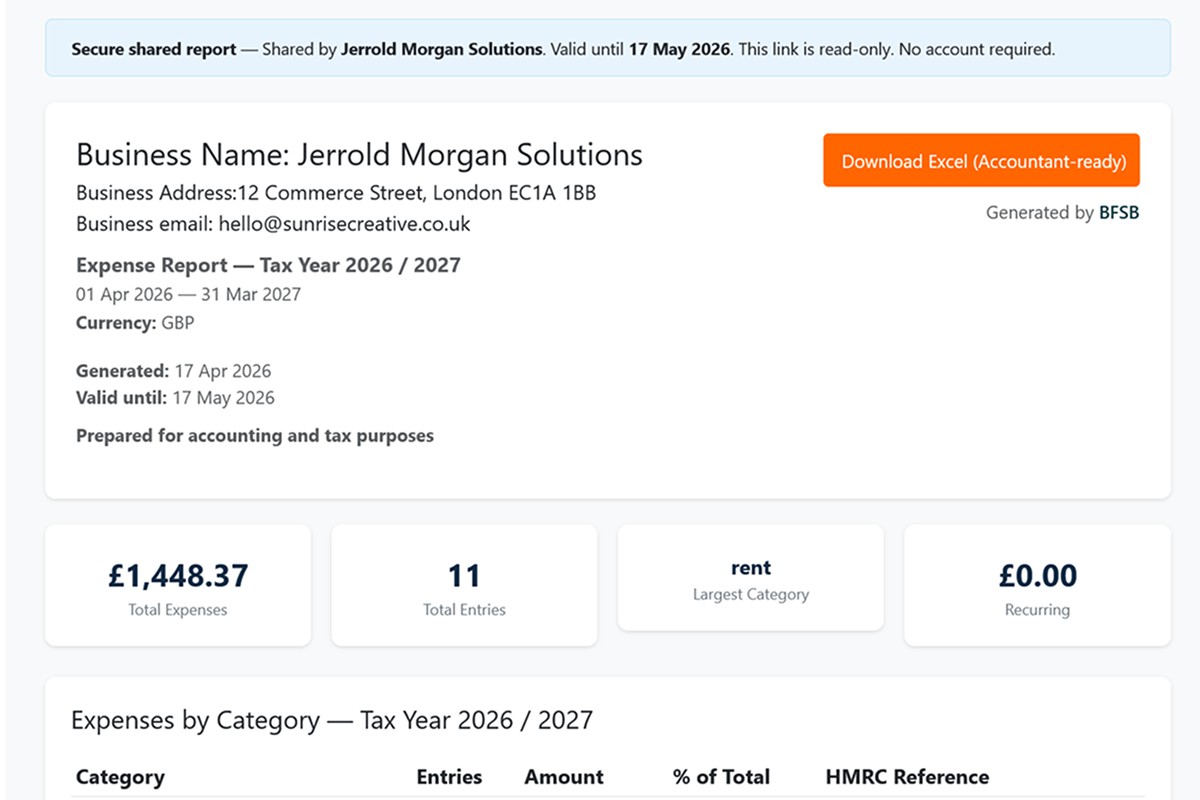
Built For Small Business logs your expenses throughout the year and maps them to HMRC categories automatically. At tax time, you open the expenses section, select the tax year, and see your full breakdown, total by category, count of entries, percentage of total spend, and the HMRC reference for each category.

You can share this directly with your accountant using a secure link. They open it in their browser, no login required, and see exactly what they need:
- Total expenses for the tax year
- Category breakdown with HMRC references
- Individual expense list with descriptions and dates
- Receipts attached and viewable
- Excel download for their own records
On the invoicing side, BFSB gives you your total invoiced and total received for the tax year with one click, split by paid, outstanding, and overdue.
Between the two, you have everything your accountant needs, organised exactly the way they want it.
The conversation you want to have with your accountant
Instead of: "Here is a folder of stuff, sorry it is a bit of a mess."
You want: "Here is a link to my expense report, and here are my invoice totals. Let me know if you need anything else."
That conversation takes five minutes. It makes you look organised. It saves your accountant time. And it almost certainly reduces your bill.
Build the system before you need it
The sole traders who have the easiest tax season are not the ones who work hardest in January. They are the ones who built a simple system in April and stuck to it.
Built For Small Business is free forever. Start logging expenses today and have everything your accountant needs ready before they ask for it.
Related articles you might like


Share:
